Showing posts with label Trust. Show all posts

Wednesday, July 29, 2026

Two Rabbit Hunters Meet in a Forest


Imagine this: Two rabbit hunters meet in a forest.

What happens next?

Most people give one of two answers. They either continue hunting rabbits independently, or they cooperate to hunt a bear because the reward is much greater.

Both answers are reasonable, and both are common examples in economics and game theory.

But there are many other possibilities.

They might divide the forest, become long-term partners, compete for the same rabbits, or agree to hunt the bear only for one to abandon the other when things become dangerous.

All of these outcomes share one assumption: the rabbit or the bear is the prize.

What if that assumption is wrong?

🎯 The most unexpected outcome is that they stop hunting rabbits and start hunting each other - not with weapons, but with incentives.

One hunter realizes that the greatest opportunity isn't the rabbit or the bear. It's the other hunter.

His knowledge, reputation, network, customers, ideas, influence, and future opportunities become more valuable than anything the forest can offer.

The forest is just a metaphor. The same thing is happening in our world every day.

Humans don't always compete for resources. More often than we'd like to admit, they compete for the people who control those resources.

🐺 Perhaps the most dangerous predator in the forest was never the bear.

It was the hunter who had already decided that you were the most valuable prey.

💭 So... what do you think happens when the two hunters meet?

https://quangntenemy.substack.com/p/two-rabbit-hunters-meet-in-a-forest

UFMuIElmIHlvdSBhcmUgbG9va2luZyBmb3IgdGhlIHNvbHV0aW9uIGZvciBhbnkgY2hhbGxlbmdlLCBjcmVhdGUgYSBkaXNwb3NhYmxlIGVtYWlsLCBhbmQgdXNlIGl0IHRvIHNlbmQgYSByZWNpcGUgZm9yIHNoZWVwIGJicSB0byBteSBnbWFpbCBhY2NvdW50Lg==

Monday, October 13, 2025

We Built a World That Remembers Everything - Except How to Pay Attention


Ethan didn't even know he'd been exposed.
A week after a corporate data breach, the calls began.
A polite voice said his reward points were expiring - just needed to verify his booking.
The email that followed looked perfect: same logo, same tone, even his travel history matched.
It felt safe because it looked familiar.

He almost clicked. He almost believed.
Because how could a stranger know that much?

That's what data leaks do now - they don't steal your money; they steal your certainty.

Your name, your address, your travel dates, the way you type "thank you" - all small pieces of you scattered through digital space, waiting to be reassembled by someone who knows how to sound human.

Recently, a major CRM platform and its connected apps faced an incident like this -
tokens stolen, permissions misused, third-party tools quietly abused.

The core system stood firm, but its ecosystem didn't.
And that's how most breaches happen today: not through one big break, but through thousands of tiny conveniences left unguarded.

We built a world where everything connects - and then forgot what that means.
Every integration that saves time also opens a door.
Every automated process that makes work smoother also hides risk in the background.

You can't stop the world from leaking,
but you can protect your own surface area.

Start here - awareness, boundaries, and habits:

1. Awareness

- Check if your email or accounts have been part of known breaches (try Have I Been Pwned).
- Don't trust familiarity - phishing now looks personal. If a message feels too specific, that's the warning.
- Slow down when urgency speeds you up.

2. Boundaries

- Review connected apps in your most-used platforms.
- Revoke access you don't use.
- Turn on two-factor authentication - app-based, not SMS.

3. Habits

- Rotate credentials regularly.
- Separate work and personal logins.
- Never reuse passwords across systems.

The deeper truth is harder to face:
We didn't lose control of our data - we gave it away.
Piece by piece. For efficiency, for ease, for the comfort of automation.

Technology didn't betray us; it simply held up a mirror.
And in that reflection, we see how attention decays.

The next breach won't come from a hacker's brilliance - it'll come from our forgetfulness.

Protect your data like it's already public.
Protect your attention like it's your last real defense.

Also visit: https://quangntenemy.substack.com/p/we-built-a-world-that-remembers-everything

Tuesday, September 16, 2025

Surveillance vs Security: The Rotten Truth About Protection


Most 'security' today isn't protection. It's surveillance dressed as safety.

That's not paranoia. That's the reality of the digital world we live in.

The Promise of Security

When we think of "security", we imagine locks on doors, guards at gates, and firewalls keeping hackers out. Security means protection from threats. It means safety, trust, and peace of mind.

But in the digital age, security has been redefined. Instead of being about protecting you, it's increasingly about watching you.

The Shift: From Lock to Lens

Look around:
- Companies say they "monitor your activity" to prevent fraud
- Apps say they "track behavior" to personalize your experience
- Platforms say they "collect data" to make you safer

But here's the rotten twist:
All those "protections" are built on surveillance. Your patterns, preferences, and movements are logged, analyzed, and often sold.

The lock has turned into a lens.

The Illusion of Safety

And it works - because who would argue against safety?
Nobody wants fraud. Nobody wants cyberattacks. Nobody wants to be unsafe.

So we accept the cameras, the monitoring, the endless data collection. We're told it's for our own good.

❌ But here's the truth:
- The data collected for "security" often fuels profit
- The surveillance never really stops at protection
- The more we're watched, the less we own ourselves

The Rotten Incentive

The problem isn't just technical. It's systemic.

Security has become a business model.
Surveillance has become an industry.

Why? Because real security (privacy, trust, ownership of data) doesn't generate revenue. Tracking, profiling, and selling - those do.

As long as surveillance is profitable, "security" will always come with strings attached.

What Real Security Should Mean

Real security isn't about how much data you can collect.
It's about how much trust you can build without crossing the line.

✅ It should mean:
- Your data belongs to you.
- Privacy is sacred.
- Safety doesn't come at the cost of freedom.

Until we reclaim that definition, we'll keep confusing surveillance with security. And we'll keep giving away our freedom for the illusion of safety.

The Question That Matters

The real question isn't: "How secure am I?"
It's: "Who benefits from securing me?"

Because if the answer is surveillance-driven corporations and systems hungry for data, then the world isn't getting safer.
It's just getting more controlled.

Also visit: https://quangntenemy.substack.com/p/surveillance-vs-security-the-rotten

Monday, July 7, 2025

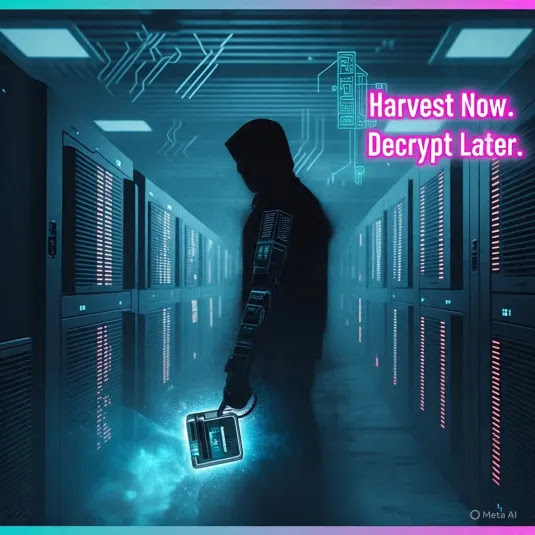
"Harvest Now, Decrypt Later" - and Nobody Cares


The quantum threat isn't some distant apocalypse.

It's happening now - just slowly enough that no one feels responsible.

Attackers are collecting encrypted data today, confident that tomorrow's quantum machines will crack it open like a cheap lock.

And why wouldn't they? Most defenders are busy chasing compliance checkboxes and pretending RSA will hold forever.

Everyone talks about “zero trust,” but they still trust 90s-era cryptography in a world that's moving toward post-truth, post-ethics, and soon, post-quantum.

The uncomfortable reality: 💀If your secrets can't survive a decade on ice, they're already compromised.

And if your org isn't even thinking about post-quantum resilience, it's not security - it's theater.

But hey, at least the slide decks look good.